

Pipeline Pigging Guide
What Is Pipeline Pigging?The Complete Australian Guide
Quick Answer
Pipeline pigging is the process of inserting a device called a pig into a pipeline and propelling it through the bore — using the existing product flow or an external medium such as water, nitrogen, or air — to clean, inspect, dewater, dry, batch, or separate products within the line. The process does not stop normal pipeline operations and is used across oil and gas, water, mining, LNG, desalination, food and beverage, pharmaceutical, and industrial pipeline networks in Australia and internationally.
Published by Royal Poly Products
Jandakot, Western Australia
Contents
1. What is a pipeline pig?
2. Why is it called a pig?
3. What does pipeline pigging do?
4. Types of pipeline pigs — complete guide
5. Foam pig density explained
6. How does the pigging process work?
7. What industries use pipeline pigging?
8. When should you pig a pipeline?
9. Pipeline pigging in Australia
10. Pipeline pigging safety
11. How do I know if pigging worked?
12. Pipeline pigging glossary
13. Frequently asked questions
1. What Is a Pipeline Pig?
A pipeline pig is an engineered device — typically cylindrical or bullet-shaped — that is inserted into a pipeline and travels along its interior length, driven by the flow of gas, water, oil, or another propulsion medium. As it travels, the pig performs work on the interior of the pipeline: scrubbing debris, removing liquid, separating products, checking bore dimensions, or recording inspection data about the pipe wall condition.
Pipeline pigs are manufactured from a variety of materials depending on their purpose. Foam pigs are made from open-cell polyurethane foam, often coated with polyurethane elastomer, silicon carbide grit, or wire brushes. Mechanical pigs (disc pigs and cup pigs) use a steel mandrel body fitted with polyurethane sealing elements. Solid cast pigs are fully moulded from polyurethane. Gel pigs are viscous liquid slugs pumped between foam pig. Intelligent inspection pigs are sophisticated electronic instruments fitted with sensors.
The design, density, coating, and configuration of the pig are selected to match the pipeline’s internal diameter, product type, debris load, operating pressure, pipeline geometry, and the specific objective of the pig run. Getting the pig specification right is an engineering decision — not a catalogue selection. Royal Poly Products’ technical team provides free pig selection consultation for Australian pipeline operators.
Australian Manufacturing
Royal Poly Products designs and manufactures its full range of pipeline pigs in Jandakot, Western Australia — meaning 3 to 10 business day lead times, direct access to the engineering team, products designed for Australian pipeline conditions, and compliance with Australian quality and safety standards under ISO 9001:2015.
2. Why Is It Called a Pig?
The term pig has been used in the pipeline industry since the earliest days of pipeline transport. The most widely accepted explanation is that the first cleaning devices — made from straw bales or leather strapping bound with wire and propelled through early petroleum pipelines — made a loud squealing noise as they traversed the bore under pressure, not unlike the sound of a pig. The name stuck and became the universal industry term worldwide.
The devices are also sometimes called scrapers, go-devils, swabs, or plugs depending on their type, configuration, and the region of the world. In Australia, pig and pipeline pig are the standard terms used by operators, contractors, engineers, and manufacturers. The process of running a pig through a pipeline is called pigging, and companies that perform this service are called pigging contractors or pigging service providers.
3. What Does Pipeline Pigging Do?
Pipeline pigging is used across a wide range of pipeline operations throughout a pipeline’s life — from pre-commissioning through to decommissioning. The specific function depends on the type of pig used and the operational objective. The main uses are:
Cleaning and internal corrosion prevention
Removing debris, scale, wax, silt, biofilm, sediment, and other contaminants from the interior bore of a pipeline. Regular cleaning pigs maintain flow efficiency and prevent the build-up that causes internal corrosion. Unpigged pipelines can lose 10 to 15 percent of their flow capacity from internal deposit accumulation over time. Cleaning pig runs are specified in Pipeline Integrity Management Plans (PIMPs) under AS 2885.3 as a key preventive maintenance measure.
Dewatering after hydrostatic pressure testing
After hydrostatic pressure testing — which is mandatory for virtually all new pipeline installations in Australia under AS 2885.5 — the pipeline must be completely dewatered before it can be commissioned for gas or product flow. Foam pigs are the primary tool for dewatering operations, typically run in a sequence of 3 to 5 passes using progressively firmer pigs to remove bulk water and then residual moisture.
Drying
Following dewatering, a drying pig removes residual moisture from the pipe wall surface. This is critical for gas pipelines where even small quantities of water cause internal corrosion, gas hydrate formation, and product quality failures. Low density fully coated foam pigs (LD-FC Series) are the standard choice for drying passes.
Batching and product separation
In multi-product pipelines, pigs physically separate different products as they are pumped sequentially through the same line. This prevents contamination and mixing at product changeover points. Disc pigs, solid cast pigs, and gel pigs are all used for batching and product separation in refined product pipelines, chemical lines, and food and beverage pipelines.
Line proving and gauging
A gauging pig carries a metal gauge plate with a diameter slightly smaller than the pipe bore. As the pig travels through the pipeline, any deformation, obstruction, or weld intrusion bends the plate. Inspecting the plate after retrieval reveals the internal condition and any restrictions. This is the mandatory first step in any new pipeline commissioning sequence — confirming the bore is clear before water is introduced for hydrotesting. Royal Poly Products’ Smart Gauge Plate service records restriction location data electronically, eliminating the need to excavate the pipeline to locate obstructions.
Inline inspection and integrity management
Intelligent pigs — also called smart pigs, ILI tools, or inspection pigs — are fitted with electronic sensors that measure and record the internal condition of the pipeline wall as they travel. Technologies include Magnetic Flux Leakage (MFL) for general corrosion detection, Ultrasonic Testing (UT) for precise wall thickness measurement, Caliper/Geometry tools for bore deformation detection, and Electromagnetic Acoustic Transducers (EMAT) for crack detection in dry gas pipelines. The data is downloaded after retrieval and analysed by specialist engineers to identify integrity threats under the pipeline’s Pipeline Integrity Management Plan (PIMP).
Corrosion inhibitor and chemical delivery
Pipeline gel pigs can deliver corrosion inhibitors, biocides, scale inhibitors, and oxygen scavengers to the full bore surface of the pipeline as the gel slug travels through. This provides a chemical treatment that covers every part of the internal surface — including pits, weld seams, and rough areas — with uniform chemical concentration. Gel pigs are also used for microbiologically influenced corrosion (MIC) treatment using biocide gel formulations.
Product recovery
When a pipeline is shut down or flushed, product recovery pigs drive the residual product to the receiving end before flushing commences. This reduces product waste, prevents contamination of cleaning or flushing fluids, and complies with environmental requirements for minimising product discharge. Product recovery pigging is common in refined product pipelines, LNG, chemical, and food and beverage pipelines.
4. Types of Pipeline Pigs — Complete Guide
Pipeline pigs divide into two fundamental categories: utility pigs that perform physical work, and inspection pigs that collect data. Within these categories there are many specific types, each optimised for a different application:
| Pig type | Category | Primary function | Best application | Reusable? |
|---|---|---|---|---|
| Foam pig | Utility | Cleaning, drying, dewatering, batching | New commissioning, light-medium cleaning | No — single use |
| Disc pig (bi-directional) | Utility / mechanical | Sealing, liquid removal, product separation | Lines without launcher/receiver | Yes — replace discs |
| Cup pig | Utility / mechanical | Heavy debris removal, long-run cleaning | Gas and water pipelines, long distance | Yes — replace cups |
| Solid cast pig | Utility | Batching, product separation, dewatering | Multi-product pipelines, post-hydrotest | No |
| Dual diameter pig | Utility | Cleaning/dewatering across bore changes | Pipelines with varying diameter sections | No |
| Gel pig | Utility / chemical | Chemical cleaning, corrosion inhibition, fine debris | Pre-commissioning, difficult deposits | No — single use |
| Gauging pig | Inspection prep | Bore measurement, obstruction detection | Pre-ILI, new pipeline qualification | No |
| Batching pig | Utility | Product separation in multi-product lines | Refined product pipelines | Yes |
| Inline inspection (ILI) | Inspection | Corrosion, metal loss, crack detection | Integrity management programs | Yes — service tool |
Royal Poly Products manufactures all utility pig types listed above — foam pigs, disc pigs, cup pigs, solid cast pigs, dual diameter pigs, and pipeline gels — from its facility in Jandakot, Western Australia. The company also provides inline inspection services and Smart Gauge Plate gauging as part of its pipeline services offering.
Key point — foam pigs vs mechanical pigs
Foam pigs can navigate pipelines that are not fully piggable — including non-full-bore valves, tight bends, weld intrusions, and diameter changes. Mechanical pigs (disc and cup pigs) require a fully piggable pipeline with full-bore valves, correct bend radii, and consistent bore. Always confirm piggability before specifying a mechanical pig. When in doubt, start with a foam pig.
5. Foam Pig Density Explained
Foam pigs are the most widely used pipeline pig in Australia. They are available in four standard densities, each suited to different operational requirements. Selecting the correct density is one of the most critical decisions in pipeline pigging — too light and the pig bypasses product without cleaning; too heavy and it risks becoming stuck at a bore restriction.
| Density | kg/m3 | Typical use | Pipeline type | Coating options |
|---|---|---|---|---|
| Low (LD) | 16-32 | Line proving, drying, initial dewatering | New pipelines, gas lines | BR, XX, FC, SC, NW |
| Intermediate (ID) | 40-56 | Light cleaning, batching, dewatering | Water mains, product lines | BR, XX, FC, SC, NW |
| Medium (MD) | 80-96 | General cleaning, debris removal | Oil, gas, water pipelines | BR, XX, FC, SC, CW, SW, NW, TW |
| High (HD) | 128-160 | Heavy scale, wax, corrosion removal | High-pressure oil and gas | BR, XX, FC, CW, SW, NW, TW |
Foam pig coating options
In addition to density, foam pigs can be coated in a variety of ways to enhance performance:
• Criss-cross coated (XX Series) — Spiral polyurethane pattern creating a continuous wiping action. The most commonly used coating for routine Australian pipeline cleaning.
• Fully coated (FC Series) — Solid polyurethane shell for maximum liquid seal and extended pig life. Best for drying passes.
• Silicon carbide coated (SC Series) — Abrasive grit coating for aggressive scale, rust, and corrosion product removal.
• Nylon wire brush (NW Series) — Non-sparking, non-contaminating mechanical cleaning. Suitable for potable water, food-grade, and classified area pipelines.
• Carbon steel wire brush (CW Series) — Aggressive mechanical cleaning of hard scale and deposits in compatible steel pipelines.
• Stainless steel wire brush (SW Series) — Used where carbon steel contamination is not acceptable — stainless steel, food-grade, and pharmaceutical pipelines.
Golden rule of foam pig selection: always start lighter than you think you need. In any new or previously unpigged pipeline, always run a low density bare foam pig (LD-BR) as the first pig to confirm the bore is clear before escalating to more aggressive pigs.
6. How Does the Pigging Process Work?
The pigging process follows a well-established sequence used on pipelines across Australia and internationally. Understanding the process helps operators plan pig runs correctly and avoid the most common causes of stuck pigs and failed operations.
Step 1 — Pig selection
The pig type, size, density, and coating are chosen based on the pipeline’s internal diameter, operating conditions, product type, pipeline geometry, debris type and volume, and the pigging objective. Royal Poly Products’ technical team provides free selection consultation at royalpolyproducts.com/get-a-quote.
Step 2 — Pre-run checks
Before launching any pig, the operator must confirm: all mainline valves are full-bore and in the open position, the receiver is correctly configured and drain is connected, pig signalers are installed at key tracking points, and an emergency pig retrieval plan is documented.
Step 3 — Pig insertion into launcher
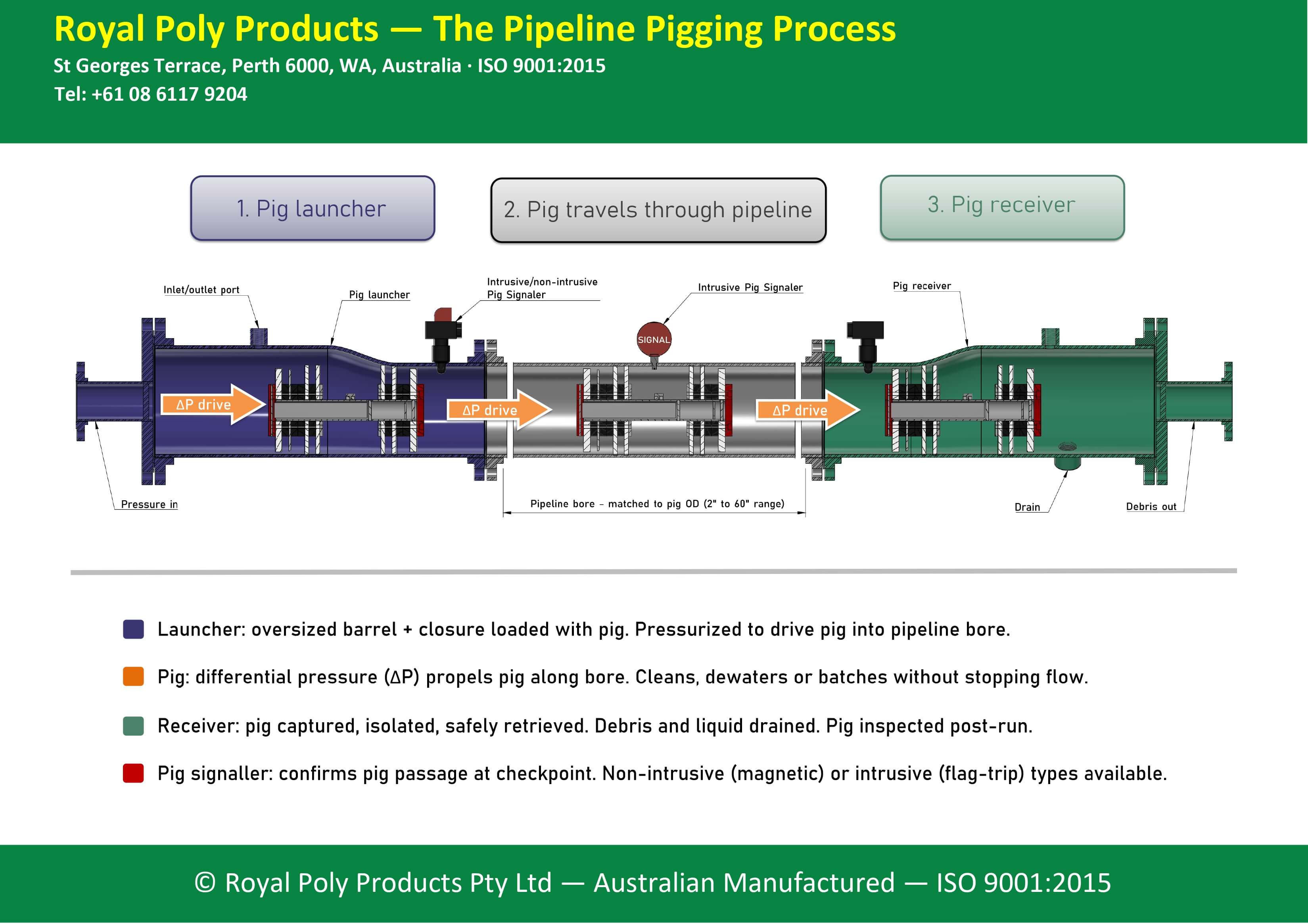
The pig is loaded into the pig launcher — an oversized barrel section of the pipeline fitted with an isolation valve and closure door. On smaller pipelines (2 inch to 6 inch), a pig can be inserted directly into a valve or tee without a dedicated launcher barrel.
Step 4 — Launching
The launcher is closed and pressurised. The differential pressure (delta P) between the launcher and the downstream pipeline propels the pig into the bore. The pig travels at a speed proportional to the pipeline flow rate — typically 0.5 to 5 metres per second. The pig speed is monitored to ensure it does not travel too fast (which can cause damage) or too slow (which can cause stalling).
Step 5 — Tracking
Pig signalers — either intrusive (contact-based, using a spring-loaded flag or switch that the pig physically trips) or non-intrusive (magnetic detection from outside the pipe wall) — are positioned at key points along the pipeline to confirm the pig has passed. The passage time at each signaler is recorded to calculate pig travel speed and estimate arrival time at the receiver.
Step 6 — Receiving
At the far end of the pipeline, the pig is captured in a pig receiver — a similar oversized barrel section. The receiver is isolated, depressurised, drained, and the pig is safely removed. The receiver drain is inspected for debris volume and type, water volume, and any material that indicates the internal pipeline condition.
Step 7 — Post-run assessment
The pig is inspected for wear, debris, coating condition, and structural integrity. The type and volume of debris recovered informs decisions about whether additional pig runs are required with more aggressive pig types. This data is recorded in the pig run log for PIMP documentation requirements under AS 2885.3.
One of the major advantages of pipeline pigging is that the pipeline can continue operating normally throughout the entire pigging process. Product flow does not need to stop — the pig simply travels with the product.
7. What Industries Use Pipeline Pigging?
Pipeline pigging is used across virtually every industry that relies on pipeline infrastructure. While oil and gas is the most widely known application, pigging is equally critical in water utilities, mining, LNG, desalination, food and beverage, pharmaceutical, and industrial process industries. The following table shows the most common industries and their pigging requirements:
| Industry | Pipeline product | Pigging frequency | Primary pigging objective |
|---|---|---|---|
| Oil and gas | Crude oil, natural gas | Every 6 months to 5 years | Wax removal, corrosion control, pre-ILI cleaning, commissioning |
| Water utilities | Potable water, raw water | Every 1 to 5 years | Biofilm removal, tuberculation, sedimentation, water quality compliance |
| Mining | Slurry, process water | Every 3 to 12 months | Scale removal, abrasive deposit control, flow efficiency maintenance |
| LNG / offshore | LNG, condensate, gas | Project-specific | Commissioning, dewatering, pre-ILI cleaning, pigging for flow assurance |
| Desalination | High-purity water | Every 1 to 3 years | Scale and mineral deposit removal, high-purity water quality maintenance |
| Food and beverage | CIP fluids, product | Every 1 to 6 months | Product recovery, CIP cleaning, batching, cross-contamination prevention |
| Pharmaceutical | High-purity process fluids | Frequent — validated cycles | Product recovery, sterile cleaning, batch separation, CIP validation |
| Chemical / industrial | Process chemicals | Varies by product | Batch separation, product recovery, cleaning, corrosion inhibitor application |
Pipeline pigging in the oil and gas industry
Oil and gas pipelines are the largest market for pipeline pigging in Australia. Gas transmission pipelines across Western Australia, Queensland, New South Wales, and South Australia are pigged regularly for cleaning and are subject to periodic inline inspection campaigns under AS 2885.3. Crude oil pipelines are pigged frequently — often every 6 to 12 months — due to wax deposition rates in Australian crude. LNG pipelines and offshore tiebacks require specialist pigging solutions including dual diameter pigs and high-specification pre-ILI cleaning sequences.
Pipeline pigging for water utilities in Australia
Australian water utilities — including Water Corporation WA, SA Water, Sydney Water, Melbourne Water, Hunter Water, and various local government water authorities — operate extensive pigging programs on water transmission mains and distribution pipelines. Water main pigging removes biofilm, tuberculation, and sedimentation that reduces flow capacity and affects water quality compliance under the Australian Drinking Water Guidelines (ADWG).
For new water main commissioning, foam pigs are used for dewatering and cleaning before disinfection and bacteriological sampling. For operational water mains, regular foam pig cleaning runs remove the internal deposits that cause turbidity events, taste and odour complaints, and pressure drop. Royal Poly Products supplies potable-water-grade foam pigs manufactured from materials certified for contact with drinking water.
Pipeline pigging for mining in Australia
Mining pipeline pigging in Australia covers two main applications: slurry pipeline cleaning to remove abrasive mineral deposits and prevent blockages, and process water pipeline cleaning to maintain flow efficiency and remove scale. Western Australian iron ore, gold, and lithium operations, Queensland coal mines, and South Australian copper and uranium operations all use pipeline pigging as part of their maintenance programs. Mining pipelines often require high-density wire brush pigs and frequent cleaning programs due to the abrasive nature of transported materials.
Pipeline pigging for food, beverage and pharmaceutical industries
Food, beverage, and pharmaceutical pipelines use pigging for product recovery, CIP (Clean-in-Place) cleaning, and batch separation. In these industries, pigs are used to push residual product from the pipeline before cleaning, reducing product waste and preventing contamination between batches. Pig materials must be food-grade or pharmaceutical-grade — stainless steel wire brush, nylon wire brush, or polyurethane foam pigs certified for product contact. Royal Poly Products can supply pigs with appropriate food-grade or pharmaceutical-grade material certifications on request.
8. When Should You Pig a Pipeline?
Pipeline pigging should be performed at several key points throughout a pipeline’s operational life:
New pipeline commissioning
Before a new pipeline is placed into service, a complete commissioning pigging sequence is required: gauge plate run to confirm bore clearance, flood pig ahead of hydrostatic test water, dewatering passes after testing, cleaning passes to remove construction debris, and drying passes before gas or product introduction. This sequence is mandatory under AS 2885 and relevant state pipeline safety legislation.
Routine maintenance cleaning
Operational pipelines accumulate internal deposits over time. A scheduled cleaning program maintains flow efficiency, reduces internal corrosion risk, and prepares the pipeline for periodic inline inspection. The required frequency is specified in the pipeline’s PIMP and determined by the threat assessment under AS 2885.3. Typical frequencies range from every 6 months (crude oil) to every 1 to 5 years (gas, water).
Before inline inspection campaigns
Before a smart pig run, the pipeline must be cleaned to the cleanliness standard specified by the ILI tool vendor. Debris on the pipe wall between the inspection tool’s sensors and the pipe surface degrades data quality and may damage the tool. Pre-ILI cleaning typically uses 2 to 4 medium density criss-cross foam pig runs, potentially escalating to silicon carbide pigs, followed by a gauging pig to confirm bore clearance.
After shutdown or extended lay-up
Pipelines that have been shut down, flooded, or left idle may accumulate significant debris and require dewatering and cleaning before returning to service. Extended lay-up can accelerate internal corrosion and create significant debris loads that require more aggressive cleaning sequences than a pipeline in regular operation.
Following integrity anomaly detection
When an ILI campaign identifies accelerating internal corrosion or significant debris accumulation, the PIMP response may include increasing cleaning pig frequency or initiating a corrosion inhibitor gel pig program to reduce corrosion rates while longer-term remediation is planned.
9. Pipeline Pigging in Australia
Australia has one of the most extensive pipeline networks in the Southern Hemisphere — more than 40,000 kilometres of gas and liquid petroleum transmission pipelines, plus extensive distribution networks in all major cities and regional centres. Pipeline pigging is carried out year-round on these networks by pipeline operators, maintenance contractors, and specialist pigging service providers.
Australian regulatory framework
High-pressure gas and liquid petroleum pipelines in Australia are regulated under AS 2885 (Pipelines — Gas and Liquid Petroleum). Operators are required to maintain Pipeline Integrity Management Plans (PIMPs) under AS 2885.3 that include scheduled inspection and cleaning programs. State-based pipeline safety regulators — including the Energy Safety Regulator in Western Australia and the Australian Energy Regulator (AER) nationally — oversee compliance with AS 2885 and state pipeline safety legislation.
Western Australian pipeline network
Western Australia has more than 15,000 kilometres of gas transmission pipelines — the most extensive network of any Australian state. Major pipelines include the Dampier to Bunbury Natural Gas Pipeline (DBNGP), the Goldfields Gas Transmission (GGT) pipeline, and the extensive networks serving the Pilbara and Mid-West regions. Royal Poly Products’ Jandakot facility supplies pigging equipment to WA pipeline operators with 3 to 10 business day delivery to Perth metropolitan and regional WA project sites.
Australian water utility pigging
Water transmission mains and distribution pipelines operated by Australian water utilities run extensive pigging programs to maintain flow capacity and water quality compliance. Water Corporation WA, SA Water, Sydney Water, Melbourne Water, Hunter Water, and Unitywater are all significant users of pipeline pigging technology in Australia.
★ Australian-made pipeline pigs
Royal Poly Products is based in Jandakot, Western Australia — just minutes from the Port of Fremantle. Australian manufacture means 3 to 10 business day lead times versus 6 to 16 weeks for imported pigs, direct access to Australian engineers familiar with AS 2885 and local pipeline conditions, and no supply chain vulnerability to global shipping disruptions. The company exports to clients in Southeast Asia and the Middle East and is a recipient of the Western Australian Export Award (Emerging Exporter 2025) and the Australian Export Award.
10. Pipeline Pigging Safety
Pipeline pigging is inherently safe when performed by qualified personnel following established procedures. However, pigging operations involve high-pressure systems, moving mechanical components, and potentially hazardous pipeline products — making safety planning essential. The following safety considerations apply to all pigging operations:
Pressure control and pig launch safety
The pig launcher and receiver must be correctly rated for the operating pressure of the pipeline. Before opening any closure, the operator must confirm the system is fully depressurised and drained. Pressurised closures are one of the highest-risk items in pigging operations — safe operating procedures (SOPs) for launcher and receiver operations are mandatory under Australian WHS legislation.
Pig tracking and position awareness
A pig that cannot be located is a serious safety and operational risk. Pig signalers must be installed at sufficient intervals to allow the pig’s position to be confirmed during the run. If a pig fails to arrive at the receiver within the expected time window, the pipeline must be isolated and the pig located before operations resume. Royal Poly Products supplies both intrusive and non-intrusive pig signalers for all pipeline sizes.
Stuck pig prevention
A stuck pig is one of the most serious operational incidents in pipeline pigging. Prevention requires correct pig selection (always start with a low density bare foam pig in unknown pipelines), verification that all valves are full-bore and open before launching, and confirmation of bore clearance using a gauging pig before running more aggressive pigs. If a pig does become stuck, a qualified pigging engineer should be consulted before applying additional pressure — excess pressure on a stuck pig can cause significant pipeline damage.
Product release and environmental management
Pipeline pigs push product ahead of them — at the receiver, the arriving pig is followed by a slug of pipeline product. The receiver must be configured to safely collect and dispose of the product that arrives with the pig. For gas pipelines, venting arrangements and flare connections must be in place. For liquid pipelines, collection vessels must have sufficient capacity for the product volume that will be displaced by the pig run.
AS 2885 compliance
Pigging operations on gas and liquid petroleum pipelines in Australia must be conducted in accordance with the pipeline’s PIMP under AS 2885.3. This includes maintaining pig run records, documenting debris assessments, and reporting any incidents (including stuck pigs) to the relevant state pipeline safety regulator. Non-compliance with AS 2885 is an offence under state pipeline safety legislation.
11. How Do I Know If Pigging Worked?
Confirming that a pig run has achieved its objective is one of the most important — and most frequently overlooked — steps in the pigging process. The following indicators are used to assess whether a pig run was successful:
Pig condition on retrieval
The pig should arrive at the receiver in good condition — intact, with wear patterns consistent with the expected pipeline internal condition. A pig that arrives severely degraded, fragmented, or covered in debris indicates a more contaminated pipeline than expected and may require additional pig runs with progressively more aggressive pig types.
Debris volume and type
The volume and type of debris recovered at the receiver after each pig run is the primary indicator of cleaning progress. For new pipeline commissioning, the debris should be predominantly construction material (weld spatter, mill scale, sand, grit). For operational pipeline cleaning, debris should include wax, silt, corrosion products, and scale. The cleaning sequence is complete when successive pig runs recover minimal debris.
Water volume recovery (dewatering)
For dewatering operations, the volume of water recovered at the receiver is recorded after each pig run and compared to the theoretical pipeline volume. Dewatering is complete when two consecutive pig runs arrive dry — no visible moisture on the pig surface and no free liquid in the receiver drain.
Flow efficiency improvement
Following a cleaning pig program on an operational pipeline, the improvement in flow efficiency — measured as a reduction in differential pressure across the pipeline section at a given flow rate — confirms that the cleaning objective has been achieved. Significant flow efficiency improvements of 5 to 15 percent are common following cleaning of pipelines that have been operating without pigging for several years.
ILI data quality (post-inspection)
For pre-ILI cleaning programs, success is confirmed by the ILI tool vendor’s assessment of data quality after the inspection run. Good data quality — consistent signal strength, minimal noise, clear anomaly signals — confirms that the pre-ILI cleaning achieved the required bore cleanliness standard.
12. Pipeline Pigging Glossary
The following terms are commonly used in pipeline pigging operations, engineering specifications, and AS 2885 documentation in Australia:
| Term | Definition |
|---|---|
| Pig | A device inserted into a pipeline to perform cleaning, inspection, separation, or measurement tasks. |
| Pig launcher | An oversized barrel section at the start of the pig run fitted with a closure and isolation valve for safe pig insertion. |
| Pig receiver | An oversized barrel section at the end of the pig run for safe pig retrieval and collection of debris and liquid. |
| Pig signaler | A device mounted on the outside of the pipeline that detects when a pig passes — used for tracking pig position during the run. |
| Differential pressure (delta P) | The pressure difference between the upstream and downstream sides of the pig that drives it through the pipeline. |
| Pig bypass | Condition where product flows past the pig rather than driving it — caused by insufficient pig density or undersized pig for the bore. |
| Piggability | Whether a pipeline can be pigged with a given pig type — determined by valve type, bend radii, bore consistency, and launcher/receiver availability. |
| ILI (Inline Inspection) | The use of a smart pig to collect data about internal pipe wall condition — corrosion, metal loss, cracks, deformation. |
| MFL (Magnetic Flux Leakage) | The most common ILI technology — magnetises the pipe wall and detects metal loss through flux leakage measurement. |
| UT (Ultrasonic Testing) | ILI technology using ultrasonic pulses to measure pipe wall thickness — requires liquid coupling. |
| EMAT | Electromagnetic Acoustic Transducer — ILI technology for crack detection in dry gas pipelines without liquid coupling. |
| MAOP | Maximum Allowable Operating Pressure — the highest pressure at which a pipeline may be operated under AS 2885. |
| Hydrotesting | Pressure testing a pipeline with water to verify structural integrity before commissioning — typically 1.25x MAOP per AS 2885.5. |
| Dewatering | Removing hydrostatic test water from the pipeline bore using foam pig runs before gas or product introduction. |
| Batching | Physically separating different products in a multi-product pipeline using a pig or gel slug to prevent contamination. |
| Line displacement | Replacing one fluid with another in a pipeline — typically using a pig to push the first fluid ahead of the second. |
| Corrosion monitoring | Systematic measurement of internal corrosion rates in a pipeline — informed by ILI data and cleaning pig debris analysis. |
| MIC | Microbiologically Influenced Corrosion — corrosion accelerated by microbial activity (biofilm) on the pipe wall interior. |
| PIMP | Pipeline Integrity Management Plan — required under AS 2885.3 for Australian gas and liquid petroleum pipelines. |
| AS 2885 | Australian standard for the design, construction, operation, and maintenance of gas and liquid petroleum pipelines. |
Frequently Asked Questions
What is pipeline pigging?
Pipeline pigging is the process of inserting a device called a pig into a pipeline and propelling it through the bore to clean, dewater, dry, inspect, batch, or recover product from the line. The pig travels with the existing product flow and does not require the pipeline to be shut down. Pigging is used across oil and gas, water, mining, LNG, desalination, food and beverage, pharmaceutical, and industrial pipeline networks.
What does a pipeline pig look like?
Most foam pigs look like a bullet or cylinder — rounded at the front and flat or concave at the rear. They range from a few centimetres in diameter for small-bore pipes to over a metre for large transmission lines. Mechanical pigs have a central steel mandrel body fitted with polyurethane cups, discs, or wire brushes. Gel pigs are viscous liquid slugs with no solid form. Intelligent inspection pigs look like a cylindrical electronic instrument with sensor arms that contact the pipe wall.
Can a pipeline pig get stuck?
Yes — a stuck pig is one of the most serious operational incidents in pipeline pigging. It typically occurs if the pig is oversized for a bore restriction, if there is an undetected non-full-bore valve, or if the pig disintegrates during the run. Prevention: always run a low density bare foam pig as the first pig in any new or unknown pipeline, confirm all valves are full-bore and open, and use a gauge plate pig to verify bore clearance. Royal Poly Products can supply retrieval pigs and bypass pigs for stuck pig recovery.
Do you need to stop pipeline operations during pigging?
No. One of the key advantages of pipeline pigging is that the pipeline can continue operating during a pig run. The pig travels with the product flow. The launcher and receiver are fitted with isolation valves that allow safe loading and retrieval without interrupting operations. This is why pigging is the preferred maintenance method for operational gas, water, and oil pipelines.
What is the difference between a foam pig and a mechanical pig?
A foam pig is made from polyurethane foam — flexible, compressible, and able to navigate tight bends, tees, and non-full-bore valves. A mechanical pig uses a rigid steel mandrel with polyurethane cups or discs and optionally wire brushes — providing better sealing and more aggressive cleaning but requiring a fully piggable pipeline. Foam pigs are used for commissioning, dewatering, and cleaning in all pipeline types. Mechanical pigs are used for heavy-duty cleaning and product separation in fully piggable pipelines.
What is piggability and how do I know if my pipeline is piggable?
A pipeline is considered fully piggable if it has full-bore valves, minimum bend radii that meet the pig specification (typically 3D for mechanical pigs, 1.5D for medium density foam pigs), consistent internal bore with no unpiggable reducers, and dedicated pig launcher and receiver. If a pipeline does not meet all of these criteria, foam pigs can often still be used — but mechanical pigs (disc pigs and cup pigs) require a fully piggable bore. Royal Poly Products offers pig qualification trial services to confirm piggability before operational pig runs.
What industries use pipeline pigging in Australia?
Pipeline pigging is used in oil and gas (cleaning, commissioning, ILI), water utilities (cleaning, dewatering, commissioning), mining (slurry pipeline cleaning, scale removal), LNG and offshore (commissioning, flow assurance), desalination (scale removal, commissioning), food and beverage (product recovery, CIP, batching), pharmaceutical (sterile cleaning, product recovery), and general industrial process pipelines. Royal Poly Products supplies pigs for all of these industries from its Jandakot, Western Australia facility.
What is a pig signaler?
A pig signaler is a device mounted on the outside of the pipeline that detects when a pig passes a specific point. Non-intrusive signalers detect the pig magnetically or acoustically without penetrating the pipe wall. Intrusive signalers use a spring-loaded flag or switch that the pig physically trips as it passes. Pig signalers are used to track pig position during the run, confirm the pig has passed key points, and estimate arrival time at the receiver. Royal Poly Products supplies both types.
What is the difference between online pigging and shutdown pigging?
Online pigging (also called live pigging) is performed while the pipeline continues to operate with normal product flow — the pig travels with the existing flow and does not require any interruption to operations. Shutdown pigging is performed when the pipeline is taken out of service — typically for more complex pig runs, multiple pig insertions, or when product isolation is required for safety. The vast majority of routine cleaning and commissioning pigging in Australia is performed online without shutdown.
How do I choose the right pipeline pig?
Pig selection requires seven key inputs: pipeline internal diameter (measured, not nominal), product type, pipeline geometry (bend radii, valve types, bore changes), debris type and volume, operating pressure and flow rate, distance of the run, and the pigging objective. Royal Poly Products’ technical team provides free pig selection consultation — contact the team at royalpolyproducts.com/get-a-quote with your pipeline specifications.
What regulations apply to pipeline pigging in Australia?
High-pressure gas and liquid petroleum pipelines are regulated under AS 2885 (Pipelines — Gas and Liquid Petroleum). Operators must maintain Pipeline Integrity Management Plans (PIMPs) under AS 2885.3 that include scheduled inspection and cleaning programs. State-based regulators — including the Energy Safety Regulator in WA and the AER nationally — oversee compliance. Water pipeline pigging is governed by state water authority standards and the Australian Drinking Water Guidelines (ADWG).
Need a Pipeline Pig for Your Australian Project?
Royal Poly Products designs and manufactures foam pigs, disc pigs, cup pigs, solid cast pigs, dual diameter pigs and pipeline gels right here in Western Australia. Fast turnaround, ISO 9001 certified, Australian made.
About Royal Poly Products
Royal Poly Products is an Australian manufacturer of pipeline pigs and pigging solutions, based in Jandakot, Western Australia. The company designs and manufactures a full range of foam pigs (low, intermediate, medium, and high density), bi-directional disc pigs, cup pigs, solid cast pigs, dual diameter pipeline pigs, and pipeline gels, supporting pipeline operators across Australia and internationally.
ISO 9001:2015 certified and a recipient of the Western Australian Export Award (Emerging Exporter 2025) and the Australian Export Award, Royal Poly Products combines local manufacturing expertise with global quality standards to deliver reliable pigging products for gas, water, oil, and industrial pipeline applications.
Website: royalpolyproducts.com
Phone: +61 08 6117 9204
Address: Unit 5/41 Biscayne Way, Jandakot WA 6164, Australia
Email: sales@royalmechgroup.com