

Pipeline Pigging FAQ Frequently Asked Questions
Pipeline Pigging FAQ — Frequently Asked Questions
Quick Answer
Royal Poly Products manufactures Australian-made pipeline pigs — foam pigs, disc pigs, cup pigs, solid cast pigs, dual diameter pigs, and pipeline gels — from Jandakot, Western Australia. ISO 9001:2015 certified. Lead time 3–10 business days. Free technical consultation available at royalpolyproducts.com/get-a-quote.
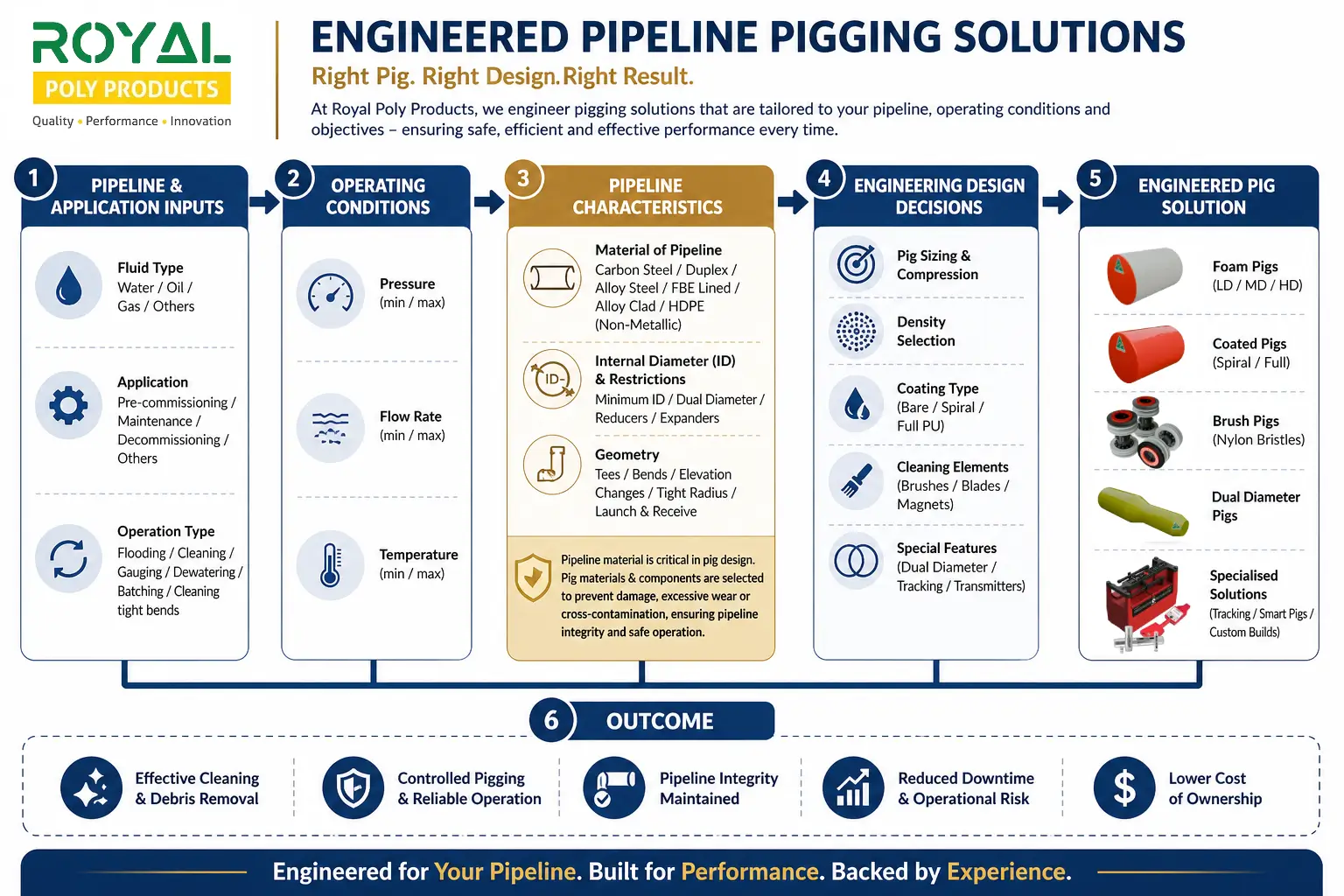
This FAQ page answers the questions Australian pipeline engineers, operators, procurement teams, and project managers most commonly ask when researching pipeline pigging solutions. Each answer links to the relevant in-depth guide in our Knowledge Kit — Pipeline Pigging Guides section for further reading.
Not sure where to start? Use this quick guide
Tell us your situation and we’ll point you to the right resource:
| Your situation | Pipeline type | What you need | Start here |
|---|---|---|---|
| New pipeline, need to commission it | Gas, water, oil | Full commissioning pig sequence | Pipeline Commissioning Guide |
| Just completed hydro test, need to dewater | Any | Dewatering pig sequence | Pipeline Dewatering Guide |
| Not sure which pig to order | Any | Pig selection guidance | How to Select the Right Pig |
| Need to clean before an inspection run | Gas or oil | Pre-ILI cleaning sequence | Pipeline Integrity Management |
| Pipeline has hard scale or heavy deposits | Gas or oil | Aggressive cleaning + gel pig option | Gel Pigging vs Foam Pigs |
| Want to understand pig types before ordering | Any | Product overview | Types of Pipeline Pigs |
| Procuring for government or major project | Any | Australian manufacturing credentials | Australian-Made Pipeline Pigs |
Section 1 — Pipeline pigging basics
1. What is pipeline pigging and why is it needed?
Pipeline pigging is the process of inserting a device called a ‘pig’ into a pipeline and propelling it through the bore — using the existing product flow or an external medium such as water, nitrogen, or air — to clean, dewater, dry, batch, or inspect the line. The process does not require the pipeline to be shut down.
Pigging is needed at every stage of a pipeline’s life. During pre-commissioning and commissioning, it removes construction debris, dewaters the line after hydrostatic pressure testing, and dries the bore before gas or product introduction. During operation, it removes deposits that reduce flow efficiency and cause corrosion. Before inline inspection, it cleans the bore to the standard required by the inspection tool.
Read more: What Is Pipeline Pigging? The Complete Australian Guide
2. Do I need pipeline pigging for my project?
If any of the following apply to your pipeline, you need pigging:
• Pipeline showing reduced flow rate or increased pressure drop — indicative of internal deposit build-up
• Pipeline due for inline inspection — pre-ILI cleaning is required before any smart pig deployment
• Pipeline that has been flooded for hydrostatic pressure testing — dewatering pigging is required before product introduction
• Operational pipeline not pigged in the last 1–5 years — routine maintenance pigging is required under most AS 2885-compliant Pipeline Integrity Management Plans
• Pipeline in potable water service showing turbidity or water quality issues — pigging removes biofilm and sediment
3. What does pipeline pigging actually do?
Depending on the pig type used, pipeline pigging performs one or more of the following functions:
• Dewatering — removes bulk water after hydrostatic pressure testing
• Drying — removes residual moisture from the pipe wall after dewatering, critical for gas pipelines
• Gauging — confirms the pipeline bore is clear and within dimensional tolerances before commissioning or ILI
• Batching — physically separates different products in a multi-product pipeline
• Product separation — prevents contamination at product changeover points
• Inline inspection — records pipe wall condition data for integrity assessment (smart pigs)
Read more: What Is Pipeline Pigging? The Complete Australian Guide
4. Can pigging be done without shutting down the pipeline?
Yes — one of the key advantages of pipeline pigging is that operations do not need to stop. The pig travels with the existing product flow. The launcher and receiver are fitted with isolation valves that allow safe pig loading and retrieval without interrupting pipeline operations. This is why pigging is the preferred method for routine maintenance cleaning of operational gas, water, and oil pipelines.
Section 2 — Pig types and selection
5. What types of pipeline pigs are available?
Pipeline pigs fall into two main categories — utility pigs (which perform physical work) and inspection pigs (which collect data). The main utility pig types are:
• Disc pigs (bi-directional pigs) — mandrel body with polyurethane sealing discs. Used for product separation, dewatering, and bi-directional operation.
• Cup pigs — mandrel body with polyurethane cup seals. High differential pressure capability for large bore pipelines and long-run cleaning.
• Solid cast pigs — fully moulded polyurethane. Used for batching, post-hydrotest dewatering, and applications requiring a durable one-piece pig.
• Dual diameter pigs — engineered for pipelines that change internal bore diameter along their length.
• Gel pigs — viscous gel slugs pumped between foam pigs for chemical cleaning, corrosion inhibitor application, and fine debris removal.
• Gauging pigs — fitted with a metal gauge plate to confirm bore clearance before commissioning or ILI.
Read more: Types of Pipeline Pigs Explained: The Complete Guide
6. How do I choose the right pig for my pipeline?
Pig selection requires seven key inputs: pipeline internal diameter (measured, not nominal), product type, pipeline geometry (bend radii, valve types, bore changes), debris type and volume, operating pressure and flow rate, distance of the run, and the pigging objective. Getting any one of these wrong is the most common cause of stuck pigs and failed pig runs.
As a starting rule: always begin with a low density bare foam pig (LD-BR) as the first pig run in any new or unknown pipeline to confirm the bore is clear before escalating to more aggressive pigs.
Read more: How to Select the Right Pipeline Pig: A Practical Guide
7. What is foam pigs density and which density do I need?
Foam pig density (kg/m3) determines how hard the pig presses against the pipe wall. Low density (LD, 16-32 kg/m3) pigs are soft and flexible — used for line proving, drying, and initial dewatering. Medium density (MD, 80-96 kg/m3) pigs are firm — used for general cleaning and progressive dewatering. High density (HD, 128-160 kg/m3) pigs are very firm — used for heavy scale and corrosion removal in confirmed clear pipelines.
Golden rule: always start lighter than you think you need. It is far easier to run a second, more aggressive pig than to recover a stuck pig.
8. What is the difference between a foam pig and a gel pig?
A foam pig is a solid object that physically sweeps and pushes debris through the pipeline bore. A gel pig is a viscous liquid slug pumped between two foam pigs that encapsulates and carries fine debris particles, and can deliver chemical treatments (corrosion inhibitors, biocides) to the full pipe bore surface. They are complementary — gel pigs capture what foam pigs dislodge but cannot carry. For most commissioning applications, foam pigs alone are sufficient. For heavy construction contamination, pre-ILI cleaning, or chemical treatment, a combined foam-and-gel sequence is recommended.
Read more: Gel Pigging vs Foam Pigs: When to Use Each
9. Can pigging be done in a pipeline that was not designed for it?
Yes — foam pigs can navigate pipelines that are not ‘fully piggable’, including pipelines with non-full-bore valves, tight bends (down to 1D minimum bend radius for low density foam pigs), weld bead intrusions, and gradual diameter changes. If the pipeline has not previously been pigged, always run a low density bare foam pig first to confirm piggability before using mechanical pigs (disc pigs or cup pigs), which require a fully piggable bore.
Section 3 — The pigging process
10. How does the pipeline pigging process work?
The standard pigging process has six steps: (1) pig selection — choosing the right type, density, and coating; (2) pig insertion into the launcher barrel; (3) launching — pressurising the launcher to propel the pig into the bore; (4) tracking — pig signalers at key points confirm the pig has passed; (5) receiving — the pig is captured in the pig receiver at the far end of the pipeline; (6) post-run assessment — the pig is inspected, water volume is recorded, and debris is assessed to determine if additional runs are required.
Read more: What Is Pipeline Pigging? The Complete Australian Guide
11. How many pig runs are needed to dewater a pipeline after hydrostatic testing?
A minimum of 3-5 pig runs is required for a standard dewatering sequence after hydrostatic pressure testing. The sequence is: LD-BR (bulk water removal x 1-2 runs), MD-BR (progressive dewatering), MD-XX (combined cleaning and dewatering), LD-FC (final drying pass). Never declare dewatering complete based on a single dry pig run — at minimum, two consecutive dry pig arrivals at the receiver are required before the pipeline is declared dry.
Read more: Pipeline Dewatering After Hydrostatic Testing: Best Practices
12. What is the complete pipeline commissioning pigging sequence?
The complete commissioning sequence for a new Australian gas pipeline has 10 steps: (1) gauge plate run to confirm bore clear, (2) flood pig ahead of hydrotest water, (3) hydrostatic pressure test — no pig, (4) dewatering pass 1 with LD-BR, (5) dewatering pass 2 with MD-BR, (6) cleaning pass with MD-XX, (7) repeat cleaning until pig arrives clean, (8) drying pass 1 with LD-FC, (9) drying pass 2 with LD-FC, (10) gas or product introduction.
Read more: Pipeline Commissioning: The Complete Pigging Sequence
13. Do I need special equipment for pigging?
Yes — a pig launcher (at the start of the pipeline section) and a pig receiver (at the end) are required. These are oversized barrel sections of pipe fitted with closure doors, isolation valves, vent valves, drain valves, and kicker line connections. For tracking pig progress along the pipeline, pig signalers are installed at key points. Royal Poly Products supplies pig signalers (both intrusive and non-intrusive types) to complement its pig range. Launchers and receivers are typically supplied by the pipeline contractor or a specialist pigging equipment supplier.
Section 4 — Risks and safety
14. What if the pig gets stuck in the pipeline?
A stuck pig is one of the most serious operational incidents in pipeline pigging, but it is preventable with correct pig selection and pre-run planning. The most common causes are: pig oversized for an undetected bore restriction, incorrect density for the operating conditions, non-full-bore valve not identified before the run, or pig disintegration. Prevention: always run a gauge plate pig on unknown pipelines before commissioning, start with low density bare foam pigs, verify all valves are full-bore and open before launching. If a pig does become stuck, Royal Poly Products can design and supply retrieval pigs and bypass pigs for recovery.
15. Is pipeline pigging safe?
Yes — when performed by qualified operators following established procedures. Key safety requirements include: correct pig selection for the pipeline conditions, pressure monitoring during pig launch and travel, pig signalers to track pig position, trained launcher and receiver operators, and a documented emergency pig retrieval plan. Royal Poly Products’ technical team provides pig selection guidance that minimises stuck pig risk as part of the standard ordering process.
16. Can pigging damage the pipeline?
Correctly specified pigs do not damage pipelines. Risks arise from incorrect pig selection — specifically, using pigs that are too aggressive (wire brush or silicon carbide coatings) in pipelines with unknown bore condition or internal coatings, or using pigs that are significantly oversized for the bore. For coated pipelines (FBE lined, cement mortar lined, HDPE lined), always specify the lining type when ordering pigs — Royal Poly Products will specify a non-metallic, coating-compatible pig configuration.
Section 5 — Commercial and procurement
17. How much does pipeline pigging cost?
Pipeline pig costs depend on the pig type, diameter, density, and coating. For indicative pricing: low density bare foam pigs (LD-BR) range from a few hundred to a few thousand dollars per pig depending on diameter. Medium density criss-cross pigs (MD-XX) are typically 20-40% more than bare foam equivalents. High density wire brush pigs are at the upper end of the range. For a specific project, the cost comparison that matters is total cost of ownership — including freight, lead time, and the cost of any commissioning delay caused by pig availability issues. Royal Poly Products provides transparent quotes at royalpolyproducts.com/get-a-quote.
18. Why should I choose Australian-made pipeline pigs?
Three critical advantages: (1) Lead time — Royal Poly Products delivers pigs in 3-10 business days vs 6-16 weeks for imported equivalents. On a critical-path commissioning project, a 12-week import lead time can cost far more in standby costs and penalties than any unit price saving. (2) Technical support — direct access to Australian engineers who know AS 2885, local pipeline configurations, and Australian climate conditions. (3) Supply chain resilience — no international shipping dependency, no customs delays, no vulnerability to global shipping disruptions.
Read more: Australian-Made Pipeline Pigs: Why Local Manufacturing Matters
19. Does Royal Poly Products satisfy local content requirements?
Yes. Royal Poly Products is an Australian manufacturer based in Jandakot, Western Australia. Its products qualify as Australian-made content under the Australian Government’s Australian Industry Participation (AIP) framework, the Western Australian Buy Local Policy, and project-specific Local Industry Participation Plans (LIPPs). Documentation to support local content submissions is available on request.
20. How do I get a quote?
Contact Royal Poly Products at royalpolyproducts.com/get-a-quote or call +61 08 6117 9204 with the following information: pipeline nominal pipe size and measured internal diameter, pipeline length, product type (gas, water, oil, chemical), pipeline geometry (minimum bend radius, valve types, any bore changes), operating pressure and flow rate available during the pig run, and the pigging objective (commissioning, maintenance cleaning, pre-ILI, dewatering, or other). The technical team will recommend the correct pig type, density, and coating and provide a project-specific quote.
Section 6 — Integrity management and maintenance
21. How often should pipelines be pigged?
The required pigging frequency is specified in the pipeline’s Pipeline Integrity Management Plan (PIMP) and is based on the threat assessment for that specific pipeline. Typical frequencies: gas transmission pipelines — every 1-5 years for cleaning, every 5-10 years for inline inspection. Crude oil pipelines — every 6-12 months for cleaning (wax deposition rate dependent). Water transmission mains — every 1-5 years. Mining process pipelines — every 3-12 months. The actual frequency for any specific pipeline must be determined by a qualified pipeline engineer based on the AS 2885.3 threat assessment.
Read more: Pipeline Integrity Management in Australia: What Operators Need to Know
22. What is a Pipeline Integrity Management Plan (PIMP)?
A Pipeline Integrity Management Plan (PIMP) is a documented plan required under AS 2885.3 for Australian gas and liquid petroleum pipelines. It identifies all credible threats to pipeline integrity, assesses the risk of each threat, and specifies the inspection, monitoring, and maintenance activities the operator will carry out to manage those threats. Pigging — both maintenance cleaning and inline inspection — is central to most Australian PIMPs. The PIMP must be reviewed and updated at regular intervals and maintained as a current document throughout the pipeline’s operational life.
Read more: Pipeline Integrity Management in Australia: What Operators Need to Know
23. What is pre-ILI cleaning and why is it important?
Pre-ILI cleaning is the pigging sequence performed before deploying an inline inspection (smart pig) tool. ILI tools require a clean bore to function accurately — debris, scale, and wax deposits on the pipe wall interfere with sensor signals, reduce data quality, and can physically damage the inspection tool. A typical pre-ILI cleaning sequence uses 2-4 medium density criss-cross foam pigs (MD-XX), potentially escalating to silicon carbide pigs (MD-SC) for hard scale, followed by a gauging pig to confirm bore clearance before the ILI tool is deployed. Inadequate pre-ILI cleaning is the most common cause of aborted ILI campaigns and repeat runs in Australian pipeline operations.
Read more: Pipeline Integrity Management in Australia: What Operators Need to Know
Still Have Questions? Talk to Our Technical Team.
Royal Poly Products' engineers are available to answer technical questions about pig selection, pipeline pigging sequences, and project-specific requirements. Based in Jandakot, Western Australia. ISO 9001:2015 certified.
About Royal Poly Products
Royal Poly Products is an Australian manufacturer of pipeline pigs and pigging solutions based in Jandakot, Western Australia. The company manufactures and supplies the complete dewatering pig sequence — LD-BR, MD-BR, MD-XX, and LD-FC foam pigs — along with pipeline dewatering gels for gel-assisted dewatering operations, supporting pipeline commissioning projects across Australia and internationally.
ISO 9001:2015 certified. Western Australian Export Award — Emerging Exporter 2025. Australian Export Award recipient. Free pig selection and dewatering sequence consultation available at royalpolyproducts.com/get-a-quote.
Website: royalpolyproducts.com
Phone: +61 08 6117 9204
Address: Unit 5/41 Biscayne Way, Jandakot WA 6164, Australia
Email: sales@royalmechgroup.com