


Pipeline Pigging Guide
Pipeline Dewatering After Hydrostatic Testing: Best Practices and Pig Selection
Quick Answer
Pipeline dewatering after hydrostatic testing uses a sequence of foam pig runs to progressively remove test water from the pipeline bore. The standard sequence is: low density bare foam pig (LD-BR) for initial bulk water displacement, followed by medium density bare or criss-cross pig (MD-BR or MD-XX) for progressive dewatering, and finished with a low density fully coated pig (LD-FC) as a final drying pass. The number of runs depends on pipeline length, bore, and profile.
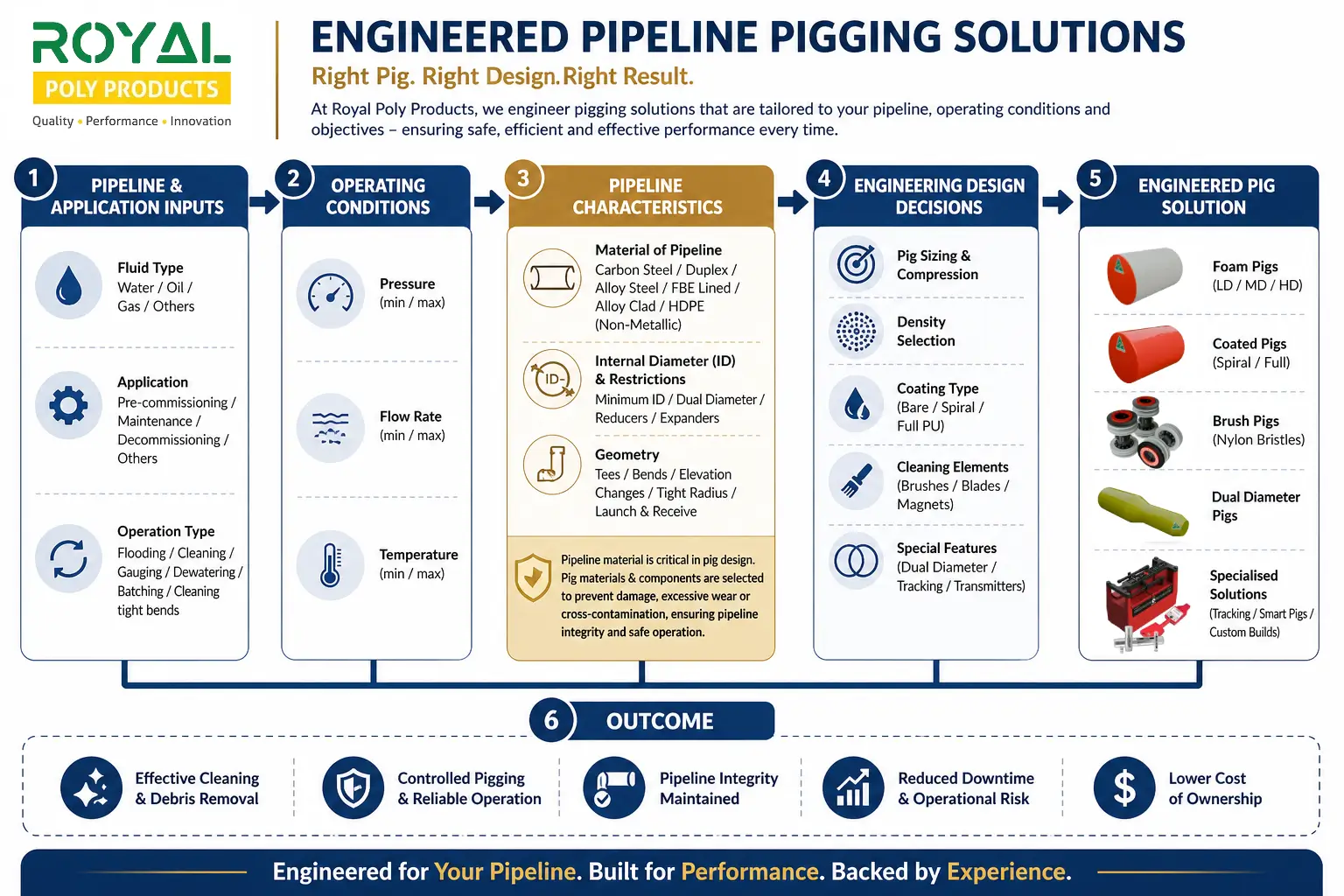
Published by Royal Poly Products
Jandakot, Western Australia
April 2026
Contents
1. What is pipeline dewatering?
2. Why dewatering is mandatory before gas introduction
3. How much water is in your pipeline? (volume reference table)
4. The standard dewatering pig sequence
5. Step-by-step dewatering sequence explained
6. Pig selection guide for dewatering
7. Dewatering challenges — low points, dead legs, and elevation
8. Gel-assisted dewatering
9. Dewatering water disposal — Australian requirements
10. Common dewatering mistakes
11. Frequently asked questions
1. What Is Pipeline Dewatering?
Pipeline dewatering is the process of removing water from a pipeline bore using foam pig runs after hydrostatic pressure testing. Hydrostatic testing — a mandatory requirement under AS 2885 for Australian gas and liquid petroleum pipelines — fills the pipeline completely with water and pressurises it to test pressure to confirm structural integrity. Once the test is complete, all of that water must be removed before the pipeline can be placed into service.
Dewatering is performed by inserting foam pigs into the pipeline at the launcher and using pump pressure or pipeline product pressure to drive the pigs through the bore. As each pig travels through the pipeline, it pushes the water ahead of it toward the receiver, where it is collected and disposed of. Multiple pig runs are required to progressively reduce the water volume from the full pipeline bore to the trace moisture level required for gas service.
Pipeline dewatering is used across oil, gas, water, mining, desalination, and process pipelines — any pipeline that undergoes hydrostatic pressure testing before commissioning, and any pipeline that has been flooded during maintenance, repair, or an emergency.
★ Key point:
Dewatering is not a single pig run — it is a progressive sequence of multiple runs using increasing pig aggressiveness and decreasing water volume recovery at each pass. Attempting to dewater a long pipeline with a single pig run almost always results in inadequate water removal.
2. Why Dewatering Is Mandatory Before Gas Introduction
Residual water in a gas pipeline causes severe operational problems that can damage equipment, disrupt supply, and create safety hazards. The consequences of inadequate dewatering in a gas pipeline include:
Gas hydrate formation
At the pressure and temperature conditions inside a natural gas pipeline, residual water reacts with gas molecules to form gas hydrates — ice-like crystalline compounds that block the pipeline bore entirely. Hydrate blockages are extremely costly to remove and can take days or weeks, during which the pipeline is out of service. Thorough dewatering and drying is the only reliable prevention.
Internal corrosion
Water in contact with carbon steel pipe wall causes rapid internal corrosion. In a gas pipeline carrying sour gas (containing H₂S or CO₂), corrosion rates with free water present can be orders of magnitude higher than in dry gas. Dewatering and drying removes the water that enables corrosion before the pipeline is placed into service.
Gas quality failure
Gas quality specifications — including those set by the Australian Energy Regulator and individual network operators — include limits on water vapour content (dew point) of gas entering transmission networks. A pipeline that has not been adequately dewatered and dried will fail gas quality testing at the inlet measurement station, preventing gas introduction until the pipeline is re-dried.
Equipment damage
Water slugs carried through gas pipelines by product flow can damage compressors, regulators, flow meters, and control valves. The kinetic energy of a water slug at gas pipeline velocities is sufficient to cause mechanical damage to rotating equipment and instrument diaphragms. Adequate dewatering eliminates this risk before operations begin.
Key point:
Under AS 2885.3, Australian pipeline operators are required to demonstrate that a new gas pipeline has been dewatered and dried to a specified standard before it can be placed into service. The dewatering pig sequence and water volume recovered at each run must be documented as part of the commissioning record.
3. How Much Water Is in Your Pipeline?
Before planning a dewatering operation, calculate the total water volume in the pipeline. This determines the number of pig runs required, the waste water disposal volume that must be planned for, and the pump capacity needed at the launcher. Use this reference table:
| Pipe NPS | ID (approx mm) | Volume per km (kL) | 10 km total (kL) | 50 km total (kL) | Disposal notes |
|---|---|---|---|---|---|
| 4″ | 97 mm | 7.4 kL | 74 kL | 370 kL | Single tanker run (multiple runs for 50 km) |
| 6″ | 150 mm | 17.7 kL | 177 kL | 885 kL | Controlled discharge to approved point |
| 8″ | 200 mm | 31.4 kL | 314 kL | 1,570 kL | Must plan disposal before commissioning begins |
| 10″ | 252 mm | 49.9 kL | 499 kL | 2,495 kL | Environmental approval often required |
| 12″ | 303 mm | 72.0 kL | 720 kL | 3,600 kL | Large evaporation pond or treatment required |
| 16″ | 397 mm | 123.7 kL | 1,237 kL | 6,185 kL | Specialist disposal contractor recommended |
| 20″ | 503 mm | 198.6 kL | 1,986 kL | 9,930 kL | Major environmental management plan required |
| 24″ | 603 mm | 285.0 kL | 2,850 kL | 14,250 kL | Significant pre-planning and approvals needed |
To calculate the exact water volume for your pipeline: Volume (litres) = π ÷ 4 × (internal diameter in metres)² × pipeline length in metres × 1000. For a pipeline with multiple wall thicknesses or bore changes, calculate each section separately and sum the results.
Key point
Always calculate the total water volume before beginning a dewatering operation. Inadequate waste water disposal capacity at the receiver is one of the most common causes of commissioning delays in Australian pipeline projects — and one of the easiest to avoid with pre-planning.
4. The Standard Dewatering Pig Sequence
The standard dewatering sequence for a new Australian gas pipeline after hydrostatic testing uses five pig runs, escalating from low density to medium density before returning to low density fully coated for the final drying pass:
| Run | Pig | Density | Series | Objective | Success criterion | Typical volume |
|---|---|---|---|---|---|---|
| 1 | Foam pig | Low (LD) | LD-BR | Bulk water displacement — remove the majority of hydrotest water | Large water volume at receiver. Pig intact on arrival. | 60–80% of total water volume |
| 2 | Foam pig | Low (LD) | LD-BR | Progressive dewatering — remove remaining bulk water | Reduced water volume. Pig may show debris. | 15–25% of total water volume |
| 3 | Foam pig | Medium (MD) | MD-BR | Deep dewatering — clear water from low points and dead legs | Minimal water volume. Pig arrives with silt or debris. | 3–8% of total water volume |
| 4 | Foam pig | Medium (MD) | MD-XX | Combined cleaning and dewatering — remove residual water + construction debris | Very low water volume. Light debris on pig. | 1–3% of total water volume |
| 5 | Foam pig | Low (LD) | LD-FC | Final drying pass — remove residual moisture from pipe wall | Pig arrives dry. No free liquid in receiver drain. | Trace moisture only |
This 5-run sequence is the standard for a new medium-length gas pipeline (typically 5–30km). Longer pipelines, pipelines with complex profiles, or heavily contaminated pipelines may require additional runs. Shorter pipelines or simple water main commissioning may be completed in 2–3 runs.
Key point:
The golden rule of dewatering: always record the water volume recovered at the receiver after each pig run. A progressive reduction in volume — 70%, 20%, 7%, 2%, trace — confirms the sequence is working. If water volume does not reduce between runs, investigate for low points trapping water before continuing.
5. Step-by-Step Dewatering Sequence Explained
Run 1 and 2 — Low density bare foam pig (LD-BR): bulk dewatering
The first one or two pig runs use low density bare foam pigs (LD-BR) for bulk water displacement. The low density pig is chosen for this phase for two reasons: first, it confirms the bore is clear of obstructions before a more aggressive pig is run; second, it generates adequate differential pressure to displace the bulk water volume without the risk of stalling that comes with a heavier pig on the first run in an unconfirmed bore.
Each LD-BR run pushes a large volume of water ahead of it to the receiver. The pig may arrive degraded after the first run through a newly constructed pipeline — this is normal, as the pig absorbs construction debris and is driven hard by the high water volume behind it. The pig is inspected on retrieval for integrity and the presence of construction debris, which informs the next stage of the sequence.
Run 3 — Medium density bare foam pig (MD-BR): progressive dewatering
Once the bulk water has been displaced by the LD-BR runs, the sequence escalates to a medium density bare foam pig (MD-BR). The firmer MD pig generates greater wall contact and differential pressure, allowing it to push water out of low points and pipeline sections that the lighter LD pig may have bypassed.
The volume of water recovered at the receiver after this run should be significantly lower than after the first two runs — typically 5–10% of total pipeline volume. If a large volume is still being recovered, an additional MD-BR run is indicated before progressing.
Run 4 — Medium density criss-cross pig (MD-XX): combined cleaning and dewatering
The fourth run uses a medium density criss-cross coated foam pig (MD-XX). At this stage in the sequence, the remaining water volume is small and the focus begins to shift from bulk liquid removal to pipe wall cleaning. The criss-cross coating creates a wiping action that removes silt, mill scale, and fine debris from the pipe wall surface — debris that would otherwise remain after dewatering and interfere with the final drying pass.
The pig should arrive at the receiver with visible debris — silt, wax, or mill scale — on its surface. This is the expected result of the cleaning action. If the pig arrives clean with minimal debris, the pipeline was in better condition than typical for new construction — which is a positive sign.
Run 5 — Low density fully coated pig (LD-FC): final drying pass
The final run uses a low density fully coated foam pig (LD-FC). The solid polyurethane shell of the FC pig provides the best liquid seal of any foam pig configuration — it picks up and carries residual moisture from the pipe wall surface that the previous pigs have left behind.
The LD-FC pig should arrive at the receiver dry — no visible moisture on the pig surface, and no free liquid in the receiver drain. This confirms the pipeline has been dewatered and dried to the standard required for gas introduction. If the pig arrives damp, a second LD-FC run is required before the pipeline can be declared dry.
Important — confirm dry before declaring complete
In some pipeline specifications, visual inspection of the final drying pig is not sufficient. A dew point measurement of the gas immediately after introduction, or a moisture content test of air or nitrogen pushed through the pipeline after drying, may be required to confirm the pipeline is dry to the specified standard. Check the project specification before declaring dewatering complete.
6. Pig Selection Guide for Dewatering
Use this guide to select the right pig for each stage of your specific dewatering operation:
| Scenario | Pipeline type | Pigging sequence | Series | Notes |
|---|---|---|---|---|
| New gas pipeline — post hydrotest | Gas transmission | LD-BR × 2 → MD-BR → LD-FC | LD-BR, MD-BR, LD-FC | Standard commissioning dewatering sequence |
| New water main — post hydrotest | Water transmission | LD-BR × 2 → MD-XX | LD-BR, MD-XX | No drying pass needed — water service pipeline |
| Long distance pipeline (>20 km) | Any | LD-BR × 3 → MD-BR × 2 → LD-FC | LD-BR, MD-BR, LD-FC | Additional passes for low point water accumulation |
| Pipeline with significant elevation change | Any | LD-BR × 2 → MD-FC → LD-FC | LD-BR, MD-FC, LD-FC | FC coating improves liquid seal at low points |
| Heavily contaminated pipeline | Gas / Oil | LD-BR → MD-XX → MD-CW → LD-FC | LD-BR, MD-XX, MD-CW, LD-FC | Add cleaning pass before final drying |
| Small bore pipeline (2–6") | Any | LD-BR → LD-FC | LD-BR, LD-FC | Short runs may dewater in 2 passes |
| Gel-assisted dewatering | Any | LD-BR → Gel slug → MD-BR → LD-FC | Pipeline Gels + foam pig series | Use when standard pigs leave residual water in dead legs |
7. Dewatering Challenges — Low Points, Dead Legs, and Elevation
The most common reason a dewatering sequence fails to achieve the required dryness level is the pipeline profile. Water naturally accumulates at the lowest points of the pipeline — and foam pigs do not always remove all of this water in a single pass.
Low points
In a pipeline with significant elevation changes, water accumulates at low points (sags) in the profile. As a foam pig traverses a low point, it must push the accumulated water uphill to the next high point before it can continue. If the differential pressure driving the pig is insufficient to lift the water column at a severe low point, the pig may stall or bypass — leaving water behind.
For pipelines with known severe low points, the dewatering sequence should include additional medium density pig runs — and consideration should be given to running pigs in the opposite direction if the pipeline geometry allows, to approach low points from the downhill side.
Dead legs and branch connections
Unprotected tee connections and dead leg sections of pipeline are not swept by a pig running in the main bore. Water trapped in dead legs remains after the main bore dewatering is complete. For gas pipelines with dead legs, options include: flushing the dead leg separately with a smaller foam pig or gel slug; purging with dry nitrogen; or accepting that the dead leg cannot be dewatered by pigging and managing the moisture through alternative means.
Elevation gain
A pipeline that rises significantly in elevation from the launcher to the receiver presents a specific challenge: the water volume to be displaced must be lifted against gravity by the pig. This requires higher differential pressure than a flat or downhill run, and may require a higher density pig (MD or HD) to generate adequate drive force. Calculate the hydrostatic head of the water column against the available pump pressure before specifying pig density for a steep uphill dewatering run.
Key point:
Always obtain the pipeline profile (elevation vs chainage) before planning a dewatering operation. Low points, dead legs, and elevation changes must be identified and their impact on the dewatering sequence assessed before the first pig run. Surprises in the pipeline profile are the most common cause of stuck pigs and failed dewatering operations in Australian pipeline commissioning projects.
8. Gel-Assisted Dewatering
For pipelines where conventional foam pig dewatering has failed to achieve the required dryness level — or where the pipeline profile is known to have severe low points and dead legs — a gel-assisted dewatering sequence can be used to achieve a higher standard of water removal.
A dewatering gel is a viscous pipeline gel formulated to seek out and absorb residual water from low points, dead legs, and rough pipe wall surfaces that foam pigs cannot effectively reach. The gel is pumped into the pipeline as a slug between foam pigs — the front foam pig prevents the gel from mixing with residual product or air ahead of it, and the rear foam pig drives the gel through the pipeline under differential pressure.
As the gel slug travels through low points and dead legs, it picks up residual water by absorption and viscous displacement. The gel arrives at the receiver laden with the water it has collected, which is then disposed of along with the gel itself.
Royal Poly Products supplies pipeline dewatering gels specifically formulated for Australian gas, water, and oil pipeline applications, alongside the foam pig sequence required to deploy them effectively. Contact the technical team for gel volume recommendations specific to your pipeline.
Key point:
Gel-assisted dewatering is particularly effective in pipelines with multiple low points, complex profiles, or where dew point specifications are very tight. The combination of foam pigs and gel typically achieves a drier result than foam pigs alone in fewer total pig runs.
9. Dewatering Water Disposal — Australian Requirements
The water removed from a pipeline during hydrostatic testing and dewatering must be disposed of in accordance with Australian environmental legislation. This is not a minor consideration — a 20″ pipeline 50km long contains nearly 10,000 kilolitres of test water, and its disposal requires pre-planning and regulatory compliance.
Onshore pipelines — key requirements
• In Western Australia, the discharge of water to ground or surface water requires approval from the Department of Water and Environmental Regulation (DWER) under the Environmental Protection Act 1986
• In all states, hydrotest water that has been in contact with the pipeline interior may contain rust, scale, mill scale, and potentially elevated metals concentrations — it is typically not suitable for direct discharge to watercourses without treatment or testing
• Test water may require pH adjustment or treatment before discharge if it has been chemically conditioned during testing (e.g. with corrosion inhibitor or oxygen scavenger)
• Disposal options typically include: approved evaporation ponds, licensed waste water treatment facilities, land application under approval, or tanker removal to an approved disposal facility
Planning disposal before commissioning begins
The most common mistake in dewatering project planning is leaving water disposal arrangements until after the pig runs have begun. Water disposal must be arranged before the dewatering sequence starts — including obtaining any necessary environmental approvals, confirming the disposal method, and ensuring adequate capacity at the receiver for the total water volume. Failing to plan disposal in advance can halt a commissioning project at the most critical stage.
Key point:
Calculate the total water volume (see Section 3 table) and arrange approved disposal before beginning the dewatering sequence. Environmental non-compliance during pipeline commissioning can result in project suspension, fines, and significant reputational damage for the pipeline owner and contractor.
10. Common Dewatering Mistakes
Attempting to dewater with a single pig run
A single foam pig run will never fully dewater a long pipeline. The pig pushes the bulk of the water ahead of it, but leaves significant residual water in low points, rough pipe wall surface areas, and dead legs. Multiple progressive runs are always required — the exact number depends on pipeline length, bore, and profile.
Starting with medium density on the first run
Starting a dewatering sequence with a medium density pig before a low density pig has confirmed the bore is clear risks a stuck pig if the hydrotest has disturbed internal debris or if weld splatter was not removed during construction. Always start with LD-BR for the first dewatering run.
Not recording water volumes at each run
Failing to measure and record the water volume recovered at the receiver after each pig run means the commissioning team has no objective measure of dewatering progress. Without this data, it is impossible to determine when the dewatering sequence is complete — or to demonstrate regulatory compliance under AS 2885. Install a flow meter or use a calibrated measurement vessel at the receiver for every pig run.
Declaring the pipeline dry after a single drying pass
A single LD-FC drying pass arriving dry at the receiver does not prove the pipeline is fully dry to the standard required for gas service. At least two consecutive dry pig arrivals should be confirmed before declaring dewatering complete. For tight dew point specifications, a moisture content measurement of purge gas through the pipeline is the most reliable confirmation method.
Inadequate waste water disposal planning
Arriving at the receiver with thousands of kilolitres of hydrotest water and no approved disposal method brings commissioning to an immediate halt. Plan disposal before the first pig run — not after.
Frequently Asked Questions
How many pig runs are needed to dewater a pipeline after hydrostatic testing?
For a typical new gas pipeline of 5–30km, a standard dewatering sequence requires 4–6 foam pig runs from first dewatering pass through to final drying pass. Longer pipelines (over 30km) typically require 6–10 runs. Short pipelines under 5km may be dewatered in 2–3 runs. The exact number depends on the pipeline length, bore, profile (low points and elevation changes), and the cleanliness standard required.
What is the difference between dewatering and drying a pipeline?
Dewatering removes free liquid water from the pipeline bore — the bulk volume of water introduced during hydrostatic testing. Drying removes the residual moisture film from the pipe wall surface that remains after all free liquid has been removed. Dewatering uses LD and MD foam pigs to displace water to the receiver. Drying uses a low density fully coated pig (LD-FC) whose solid polyurethane shell picks up and carries surface moisture. Both steps are required for gas pipeline commissioning.
Can a gel pig be used for pipeline dewatering?
Yes — dewatering gels are specifically formulated to absorb and displace residual water from low points, dead legs, and rough pipe wall surfaces that foam pigs cannot effectively reach. A gel pig sequence (front foam pig — gel slug — rear foam pig — drying foam pig) is used when standard foam pig dewatering has not achieved the required dryness level, or when the pipeline profile has severe low points that accumulate water. Royal Poly Products supplies dewatering gels alongside the foam pig sequence required to deploy them.
What foam pig series does Royal Poly Products recommend for pipeline dewatering?
The standard Royal Poly Products dewatering sequence uses: LD-BR Series (low density bare foam pigs) for the first one or two bulk dewatering runs; MD-BR Series (medium density bare foam pigs) for progressive dewatering; MD-XX Series (medium density criss-cross coated) for combined cleaning and dewatering; and LD-FC Series (low density fully coated) for the final drying pass. Contact the technical team at royalpolyproducts.com/get-a-quote for a specific sequence recommendation for your pipeline.
Does a water pipeline need to be dried after hydrostatic testing?
No — water transmission mains and distribution pipelines that will carry water in service do not need to be dried after hydrostatic testing. The dewatering sequence for water pipelines ends after the cleaning and bulk water removal passes. However, any disinfection requirements from the relevant water authority (Water Corporation WA, Sydney Water, Melbourne Water, SA Water, etc.) must be completed before the pipeline is approved for potable water service.
What happens if residual water is left in a gas pipeline?
Residual water in a gas pipeline causes gas hydrate formation (which can block the pipeline entirely), internal corrosion of the carbon steel pipe wall, gas quality specification failure at the network inlet measurement station, and potential equipment damage from water slugs at compressors and regulators. Adequate dewatering and drying before gas introduction is both operationally and regulatory mandatory under AS 2885.
How do I know when a pipeline is fully dewatered?
A pipeline is considered dewatered when two consecutive foam pig runs arrive at the receiver dry — no visible moisture on the pig surface, no free liquid in the receiver drain, and no water volume measured at the receiver outlet. For gas pipelines with tight dew point specifications, a dew point measurement of purge gas through the pipeline after the final drying pass provides the most reliable confirmation. Document all pig run results and water volumes for AS 2885 compliance records.
Dewatering a Pipeline After Hydrostatic Testing in Australia?
Royal Poly Products manufactures and supplies the complete foam pig dewatering sequence — LD-BR, MD-BR, MD-FC and LD-FC — from our facility in Jandakot, Western Australia. Fast
turnaround, ISO 9001 certified, Australian made.
About Royal Poly Products
Royal Poly Products is an Australian manufacturer of pipeline pigs and pigging solutions based in Jandakot, Western Australia. The company manufactures and supplies the complete dewatering pig sequence — LD-BR, MD-BR, MD-XX, and LD-FC foam pigs — along with pipeline dewatering gels for gel-assisted dewatering operations, supporting pipeline commissioning projects across Australia and internationally.
ISO 9001:2015 certified. Western Australian Export Award — Emerging Exporter 2025. Australian Export Award recipient. Free pig selection and dewatering sequence consultation available at royalpolyproducts.com/get-a-quote.
Website: royalpolyproducts.com
Phone: +61 08 6117 9204
Address: Unit 5/41 Biscayne Way, Jandakot WA 6164, Australia
Email: sales@royalmechgroup.com